
The Model Ally? Poland at 27 Years in NATO
On March 12, 1999, Poland, alongside Hungary and the Czech Republic, formally entered the North Atlantic Treaty Organisation (NATO), breaking the shackles of the post-Yalta order.
On March 12, 1999, Poland, alongside Hungary and the Czech Republic, formally entered the North Atlantic Treaty Organisation (NATO), breaking the shackles of the post-Yalta order. As Warsaw approaches its third decade in the transatlantic alliance, its strategic posture dampening the Cold War facade and assuming the role of NATO’s Eastern Flank vanguard. Today, Poland is frequently lauded as the alliance’s ‘‘Model Ally’’, yet the true substance of this title remains ambiguous. This piece investigates key questions concerning Poland’s strategic trajectory. It will draw upon an argument from the former Polish Ambassador to NATO, Tomasz Szatkowski and his article ‘‘Indispensable Lynchpin or Irrelevant Symbolism?’’. We will ask, what are the major causes and consequences of Poland’s ascending status in NATO, and how does the United States define a ‘‘Model Ally’’ concept. I argue that executing a true ‘‘Model Ally’’ policy requires transcending, simultaneously, the legacy of American orientation toward Western Europe, and overwhelming reliance on the American kinetic depth . European contingency demands acting as the frontline advocate for the strengthened conventional deterrence posture as a necessity to systematically deny Russian imperialism.
Prevailing over the Yalta legacy
The accession of Poland to NATO represented the de facto dissolution of the post-Yalta order. For over half a century, Polish national identity was defined by the trauma of 1945, a period of violent detachment from Western civilisation and forced degradation into the role of a Soviet satellite. Former Minister of Foreign Affairs, Bronisław Geremek immortalised this gravity shift in his speech in Presidential Library of Harry Truman in Missouri in 1999 ‘‘Poland has forever returned where it had always belonged: to the free world.’’ Geremek unequivocally pointed out that the perception of Central Eastern Europe (CEE) as a geopolitical terra nullius was not merely shifting, but permanently vanishing.
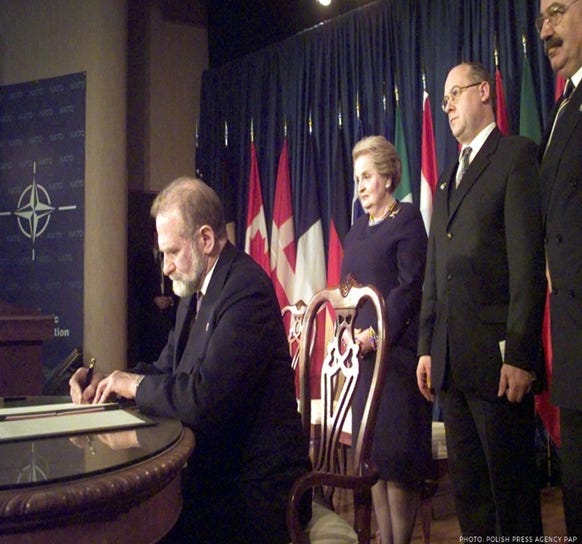
Yet, Poland’s journey did not begin with the 1999 signing ceremony, but with a calculated demonstration of strategic alignment. The post-communist intelligence services signaled the arrival of a new era as early as the 1990s by smuggling CIA assets out of Iraq in Operation Samum, effectively assisting the Desert Storm coalition before the Polish state had even fully transitioned. Szatkowski introduced the notion of a ‘‘top student in the class’’ mentality, driven by an idealised view of post-Reagan America as the ultimate guarantor of security. Warsaw’s political elite built consensus and maintained a consistent sprint toward NATO to escape the existential threat of a gray zone between the West and a resurgent Russian Federation. Alas, the ‘‘top student’’ had to accept the harsh implications of the 1997 NATO-Russia Founding Act, which constrained Poland, creating a second-tier membership and limiting the permanent stationing of allied combat troops in the CEE region.
Following the logic of bandwagoning generated political capital by standing shoulder-to-shoulder with the US ally, Warsaw began ‘‘punching above its political weight’’ by committing to out-of-area operations in Iraq and Afghanistan. This proactive policy exposed the deep rift between Old and New Europe. The infamous rebuke of former president of France Jacques Chirac, criticising the CEE states for their steadfast support of the Iraq War symbolised this rupture ‘‘These countries have lost a good opportunity to keep quiet’’. By 2006, this reliability had earned Warsaw a US request to host a key missile defence site, effectively moving Poland from a buffer state to a vital node in the US global strategic posture. Further dedication to the principles of the alliance was symbolised by Poland remaining one of the few allies to effectively implement the 2% GDP Defense Investment Pledge following the 2014 Wales Summit.
The Tragedy of the Opportunity: Russian Invasion on Ukraine
George Bernard Shaw, an Irish playwright and critic, once wrote ‘‘There are two tragedies in life. One is to lose your heart’s desire. The other is to gain it.’’. I perceive Poland’s status vindication as a natural consequence of the harsh geopolitical circumstances that realistically threaten its survival. Further, this tumultuous environment is exacerbated by the collapse of Old Europe’s credibility, with Germany at its forefront. For decades, the diplomatic rift between Western Europe and the Eastern Flank was echoed by a significant asymmetry in threat perception. While Paris and Berlin viewed Moscow through the lens of political engagement, economic interdependence and permanent crisis management, vividly illustrated by their commitment to the Nord Stream pipeline projects - Poles, Balts and Finns consistently warned of Russian imperialism. These warnings were systematically dismissed as paranoia or even Russophobia. Ultimately, it took the shock of the 2014 Crimean crisis for the United States to finally recognise Poland as a crucial hub for its European presence, initiating a shift from a limited U.S. footprint to enhanced presence, which Szatkowski recites as ‘‘command and control (C2), maintenance and logistics, combat aviation, reception staging onward movement and integration, special forces, US Air Force combat, Intelligence, Surveillance and Reconnaissance (ISR)’’ and other capabilities enabling defensive operations.
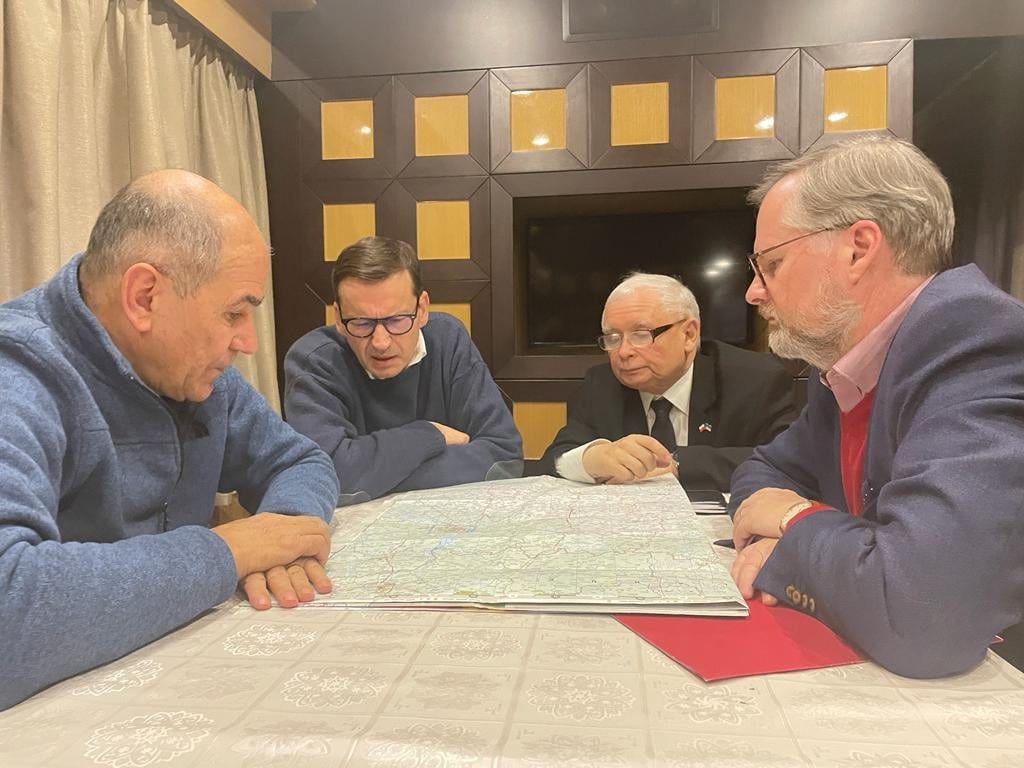
Arguably, the collaboration between Washington and Warsaw reached an unprecedented zenith following the onset of the Russian unprovoked full-scale invasion of Ukraine on 24th February 2022. Poland became a lifeline of Ukraine’s military supply, further playing an active role in organising the coalition of countries aiding Ukraine’s war effort. These developments shifted the gravity centre of the alliance towards its Eastern flank, advancing Poland’s as an indispensable hub, with Rzeszów-Jasionka airport becoming the key artery of humanitarian and military aid. Dębski notes that Polish Prime Minister Mateusz Morawiecki was among the first statesmen to arrive in war-torn Kyiv on 15th March 2022, establishing the precedent of risking a visit to a besieged capital as a powerful symbol of political support for Ukraine. Initially, high-level engagements were restricted to the Polish-Ukrainian border, for example the Blinken-Kuleba meeting. Later the rest of the West was led by the example of leaders of CEE countries, including the 46th President of the United States, Joe Biden, who boarded the train from Rzeszow to Kyiv and met president Volodymyr Zelenskyi, on 20th February 2023.
Furthermore, the grim period between December 2021 and April 2022, when the fate of Ukrainian sovereignty and the credibility of NATO’s open-door policy were at stake, can be symbolically illustrated by the strategic calculus of Finland and Sweden, which made a decision to abandon their neutral status and join the North Atlantic alliance. In early March 2022, before a summit of EU leaders in Versailles, Prime Ministers Sanna Marin and Magdalena Andersson initially appealed to the European allies, seeking reassurance of the EU’s mutual defence clause, Article 42.7 of the Lisbon Treaty. Yet, when faced with this test of continental solidarity, European leaders, to paraphrase Chirac, did not lose their opportunity to keep quiet. Thereby, in In the darkest hours of stability of European security, Helsinki and Stockholm concluded that the EU lacked not only the hard military capabilities required to contain an emboldened Russian bear but, predominantly, the political will to abandon its reliance on the peace dividend.
The Model Ally… in the making
The rhetoric of the U.S. high officials during the Munich Security Conferences in 2025 and 2026, from the blistering rebuke of JD Vance to the more pragmatic speech of Marco Rubio, sends a clear communicae, that NATO requires two pillars to withstand the challenge of the Cold War II—one American and one European. This evolving message is not merely rhetorical but is increasingly embedded in the criteria by which the United States evaluates its allies.
Although Peter K. Lee and Esther Dunay originally designed their ‘‘Model Ally’’ criteria to assess US partnerships in the Indo-Pacific, their universal metric can also be applied directly to the Transatlantic theatre. Drawing upon the core principles of the 2025 U.S. National Security Strategy (NSS) and the 2026 U.S. National Defense Strategy (NDS), they broke down Washington’s expectations into three clear criteria. First, allies must meet a defence spending target. Second, they are expected to prioritise buying American military equipment and investing in the U.S. defence industry. Third, they must provide the U.S. with access to strategically vital locations, whilst taking a greater responsibility for regional deterrence. Warsaw, to a great extent, satisfies these parameters or is on a definitive path to achieving them in near future. Nevertheless, as strategic expectations for the region escalate, a significant capability gap becomes evident, as European allies possess less industrial capacity that the United States to produce required to sustain the current status quo of regional deterrence.
1) Reaching Defence Spending Target &
2) Arms Sales and Investments in the US Industry Defence Industrial Base‘
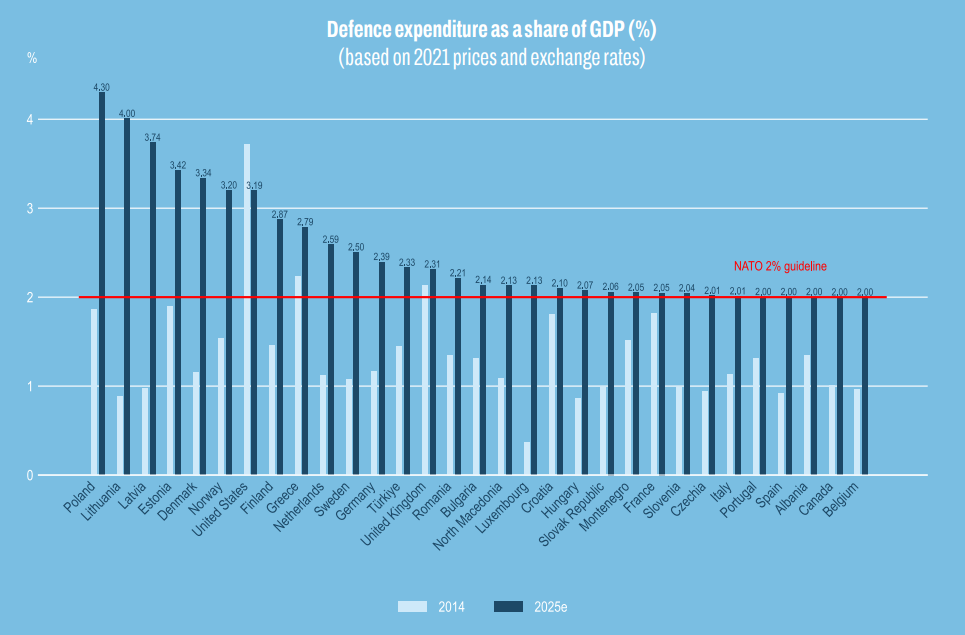
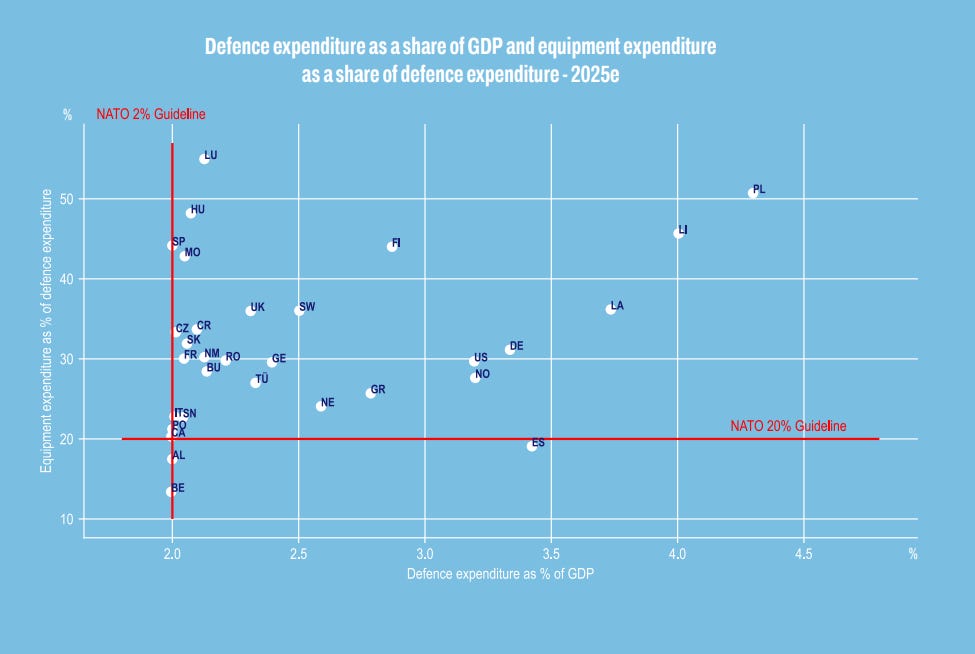
Warsaw’s leadership in defence expenditure among NATO countries effectively neutralises long-standing U.S. criticisms regarding European free-riding. February 14th 2025 displayed a glaring contrast between the two speeches of the U.S. Vice President, who spoke in Munich and Pete Hegseth who spoke in Warsaw. While J.D. Vance delivered a sharp critique of historical defence underinvestment by Western European powers in Munich, Pete Hegseth visited Poland to hail its strategic trajectory, explicitly designating Warsaw as a ‘‘Model Ally.’’ While praising Warsaw’s commitment to allocate 4.7% of its GDP to defence, Hegseth has reinforced Washington’s insistence that Europe must shoulder a significantly larger share of the transatlantic security burden.
Secondly, the vast majority of Poland’s unprecedented military build-up is driven by the American defence industry. At a time when Western Europe was haunted by fears of an American withdrawal from the continent, the RAND corporation, a leading American think-tank funded by Pentagon, published an impressive report titled ‘‘Polish Armed Forces Modernization A New Cornerstone of European Security?’’, analysing the potential strategic outcomes of this build-up.
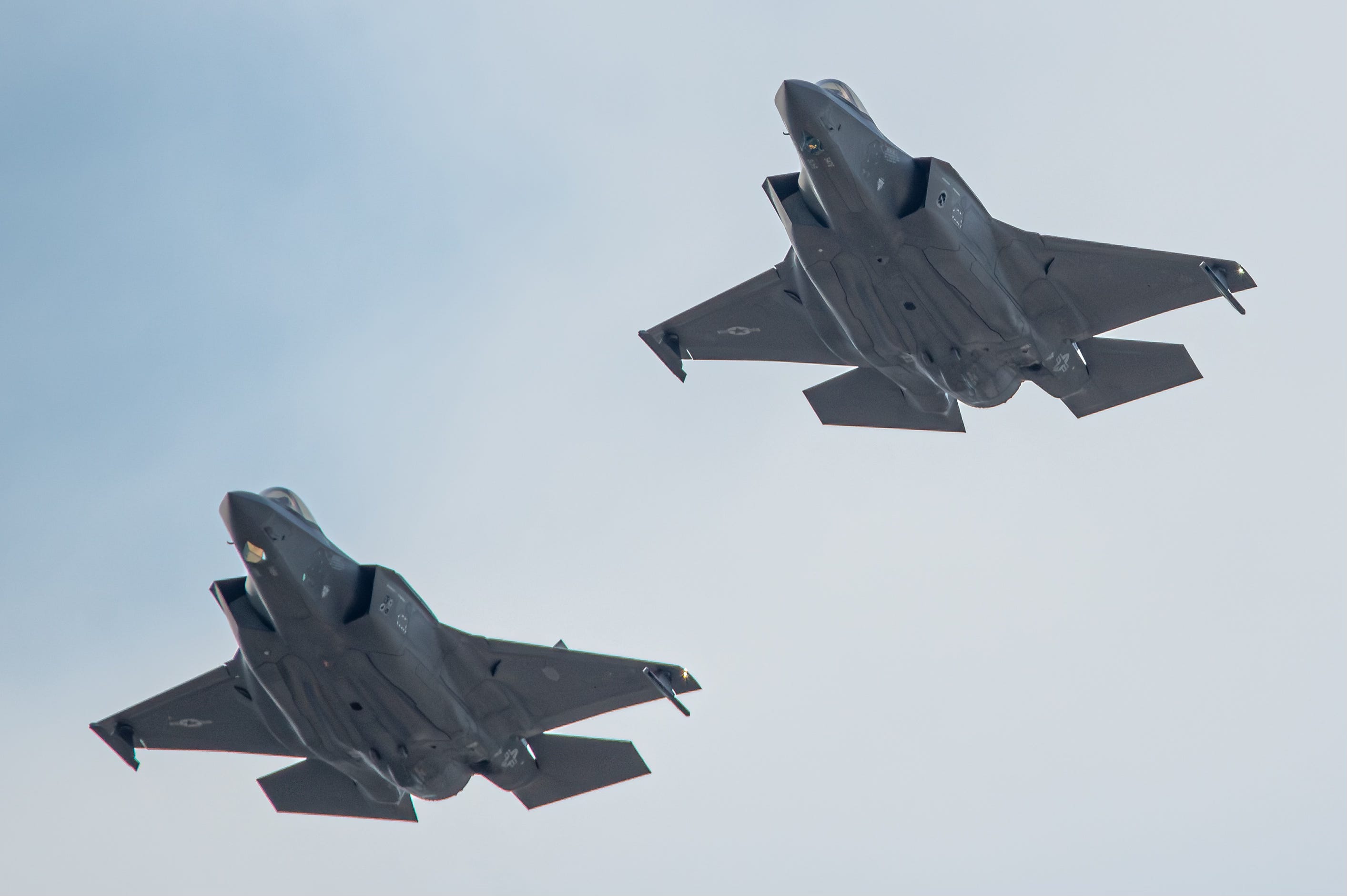
The verdict was clear. Analysts Krystyna Marcinek and Scott Boston concluded that Poland is positioning itself as a ‘‘key source of land combat power for NATO’’. Their projection is anchored in Warsaw’s investments in US heavy armour, namely, contracts for M1A1 and M1A2 SEPv3 Abrams tanks valued at $1.4 billion and $4.75 billion respectively, alongside a landmark agreement worth up to $12 billion for 96 AH-64E Apache attack helicopters. Moreover, Poland rapidly modernised its artillery and strike capabilities, which includes a framework agreement for M142 HIMARS (Homar-A) systems potentially worth $10 billion. Upon the full execution of these contracts, Poland will become the largest foreign operator of both HIMARS launchers and Apache helicopters globally. This transformation extends equally to the aerospace domain. Warsaw has committed up to $15 billion to acquire Patriot (Wisła) air defence batteries , becoming the very first foreign nation to integrate the Integrated Air and Missile Defense Battle Command System (IBCS), a highly advanced networked command architecture that aligns with US Army modernisation strategies. Finally, the Polish Air Force is stepping into fifth-generation warfare via a $4.6 billion contract for 32 F-35A Lightning II stealth fighters. RAND experts explicitly concluded that ‘‘the United States must maintain and consider temporarily strengthening its military posture in Poland in the short- to medium-term’’. With Poland undergoing such an intense process of modernising its military capabilities, it is simultaneously formulating itself as a “Model Ally”.
Washington cherishes allies who purchase its equipment not only for the direct financial benefits, but also because such profound technological reliance grants the US leverage over escalation control. As Ambassador Szatkowski has cautioned, while the transactional and strategic relationship between Poland and the United States is currently thriving, it must ultimately evolve ‘‘in the interest of more than those two allies’’.
3) Access and Taking Greater Responsibility for Regional Deterrence
While Poland unquestionably satisfies the first two benchmarks, it also fulfils the geographical prerequisite of the third. Poland has cemented itself as the robust bridge between East and West, acting as the primary hub for military equipment and supplies flowing to Kyiv. If there is any space for scepticism regarding Warsaw’s new rank within the alliance, it hinges entirely on the final, far more demanding metric, namely, taking greater responsibility for regional deterrence. Poland’s ambitious rearmament programme remains in the implementation phase. Furthermore, considering the increased frequency of military conflicts and the resulting strain on international supply chains, these acquisition timelines remain vulnerable to significant delays. The expectations placed upon Warsaw have swollen to monumental proportions, creating a significant expectation-capability gap. This fundamental dilemma forms the crux of a strategic debate between two prominent American thinkers of Central European descent, Andrew Michta and Edward Luttwak, who clashed their opinions in a series of refutals in Wall Street Journal.
Andrew Michta initiated the debate with his op-ed ‘‘Station U.S Troops in Poland, Not Germany and other allies on NATO’s Eastern flank are vital to deterrence and are pulling their weight.’’ He highlighted the role of Poland as the lynchpin of NATO deterrence and defence, which in a new strategic reality, ought to host permanent U.S. military installations. Michta argues that the fact of Germany hosting the largest American footprint in Europe: 1) floats on the legacy of West Germany in the U.S. - USSR rivalry; 2) is based on outdated assumptions that eastern members of the alliance are a lesser category of ally than traditional European powers, and finally, 3) does not withstand the new strategic reality of Russian hostility and the dynamic rearmament of the Eastern Flank. Therefore, Michta emphasised that Americans should abandon their obsolete lenses and embrace the policy, which would better reflect Poland’s role as the pivotal frontier state or in other words, New West Germany.
Luttwak, in his rebuttal, ‘‘Poland is Not the Model NATO Ally; It wastes money on fancy helicopters and target-only frigates while not doing what responsible countries near Russia must do’’ defends Germany status and shares a far more sceptical view on the actual capabilities of Poland. While comparing Poland’s military posture to the one of Finland and Sweden, he stigmatised the ‘‘irresponsible’’ policy of Polish statesmen, who keep abstaining from calling the conscription of its youth. Thereby, along his argument, Poland should not be gratified by the U.S. enhanced presence. Instead, America should set the deadline to withdraw existing personnel, unless Poland decides to act responsibly—building an army of its true demographic capacity, following the example set by Scandinavians.
These two contrasting visions adequately mirror the strategic dilemmas facing both Warsaw and Washington. Both capitals must answer a vital question: does Poland’s trajectory towards becoming the ‘‘Model Ally’’ truly align with the long-term strategic interests of both nations, or does it merely serve a transactional purpose? Drawing upon the conclusions of the RAND Corporation’s report, one can definitively state that Poland is a ‘‘Model Ally in the making.’’ It remains unclear whether this new paradigm is genuinely Polish, shaping NATO policy and preventing a new Yalta, or U.S.-designed, securing Warsaw as a key land power yet a dependent client. The answer will shape European security for decades.
—Bartłomiej Maciejewski